Planting a Balled and Burlapped Tree the Right Way
Most tree failures trace back to planting day, not the years after it.
September 23, 2026 · 3 min read
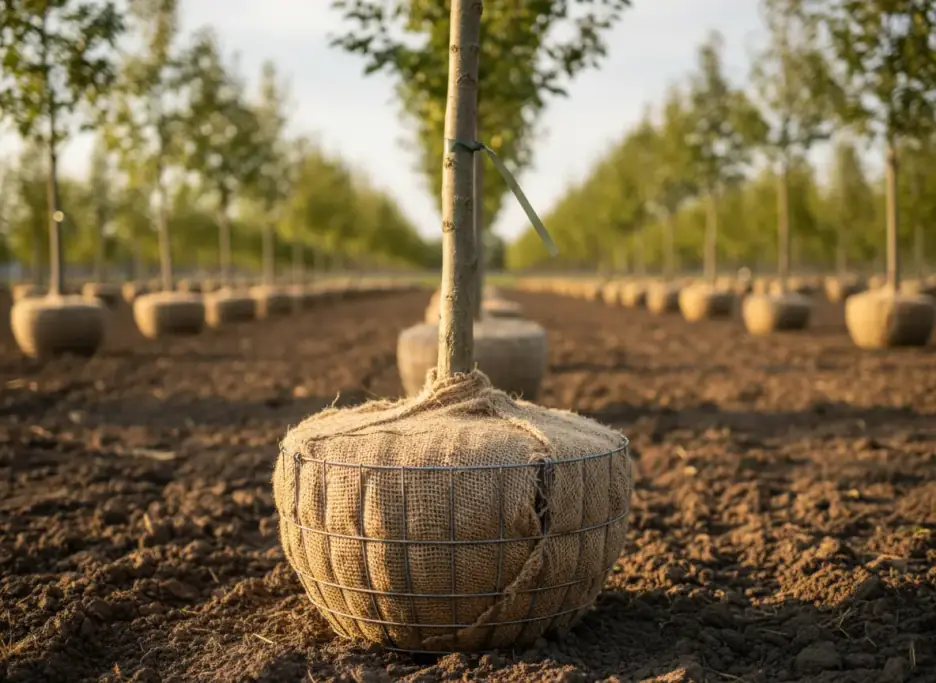
A balled and burlapped tree, often called B&B, is dug from the ground with its root ball intact and wrapped in burlap, usually with a wire basket around the outside to hold everything together during transport. It's a common way to move a larger tree than you could handle bare-root, but it comes with a few extra steps at planting time that are easy to skip and expensive to skip wrong.
Dig the hole wide, not deep
The single most common planting mistake is a hole that's too deep and too narrow. Roots grow outward far more than they grow downward, especially in the compacted or clay-heavy ground common around Pratt. Dig the hole two to three times wider than the root ball, but only as deep as the root ball itself, measured from the bottom of the ball to where the root flare sits. If the hole is dug too deep and the tree settles, the trunk ends up buried, which is one of the slowest and most reliable ways to kill a tree over several years.
Find the root flare before you set the tree
The root flare is the point where the trunk widens out into the first structural roots. On a lot of nursery-grown B&B trees, the flare is buried under an inch or two of soil and burlap by the time it arrives, so it's worth digging into the top of the ball by hand to find it before you set the tree in the hole. The flare should end up at or slightly above the surrounding grade once you're done, never below it.
Handling the wire basket and burlap
Set the tree in the hole using the root ball itself, never the trunk, to lift and position it, since lifting by the trunk can tear roots loose inside the ball. Once it's positioned and you're happy with the orientation, cut away as much of the wire basket as you can reach, at least the top third to half, and remove or fold back the burlap from around the top of the ball and the flare. Synthetic burlap doesn't break down the way natural burlap does, and even natural burlap left wrapped around the trunk can girdle it over time. If it's not synthetic, cutting it back at the top is still worth doing so it doesn't wick moisture away from the root zone.
Backfill with the native soil you dug out
It's tempting to fill the hole with rich bagged soil or compost, but heavily amended backfill can actually work against the tree: roots tend to circle within the nice soft soil instead of pushing out into the surrounding native ground, which limits stability and long-term drought tolerance. Use the same soil you removed, broken up to remove large clumps, and backfill in stages, watering as you go to settle the soil and remove air pockets without stomping it down hard.
- Dig the hole two to three times wider than the root ball, only as deep as the ball itself
- Locate the root flare before setting the tree; it should sit at or just above grade
- Lift and set the tree by the root ball, never the trunk
- Cut away the top third to half of any wire basket and remove burlap from around the flare
- Backfill with native soil in stages, watering to settle rather than tamping
- Build a shallow soil ring at the edge of the hole to hold water over the root zone
Mulch and staking, only when needed
Spread two to three inches of mulch in a ring out to roughly the edge of the planting hole, keeping it a few inches back from direct contact with the trunk. Mulch piled against the bark holds moisture against the trunk and invites rot and pests. Staking isn't automatic. A tree that stands on its own after planting is usually better off without stakes, since a trunk that can flex slightly in the wind builds stronger wood faster. Stake only if the tree genuinely can't stand upright on its own or the site is unusually exposed, and use wide, flexible ties rather than wire, removed within a year.
If you'd rather talk through the specifics for your soil and your tree before planting day, call Pratt Tree Farm at (620) 672-7134 and ask what's ready in the rows this season.
Pratt Tree Farm, (620) 672-7134
Call (620) 672-7134More articles
Picking a Shade Tree That Can Handle Pratt County Wind and Heat
The right shade tree for a Pratt County yard has to survive the wind first and look good second.
Watering a New Tree Through Its First Kansas Summer
A new tree's first summer is decided at the hose, not at the nursery.